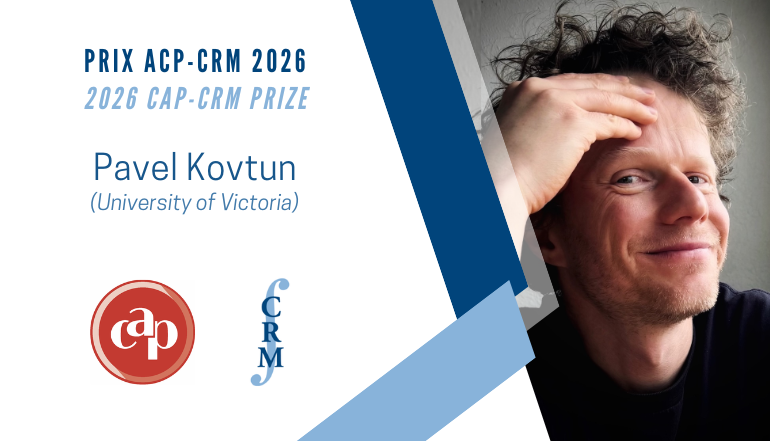
Pavel Kovtun (University of Victoria) awarded the CAP-CRM prize for 2026
Pavel Kovtun has completed his Bachelor’s degree at Kharkiv National University in Ukraine, and his PhD at the University of Washington in the United States in 2004. He was a postdoctoral fellow at the Kavli Institute for Theoretical Physics in Santa Barbara, before joining the University of Victoria in 2007.
Dr. Kovtun has made ground-breaking contributions to understanding the fundamental laws that govern matter under extreme conditions, where quantum mechanics, special relativity, statistical physics, and gravity converge. He is widely recognized for his co-discovery of the universal quantum viscosity arising from gauge-gravity duality and the associated putative viscosity bound. This discovery has had profound implications for the study of the quark-gluon plasma and other quantum fluids. Building on this foundation, his later work has catalyzed the widespread application of string theory inspired methods to study strongly coupled systems in condensed matter physics. Beyond his seminal research on gauge-gravity duality, Dr. Kovtun has also made major contributions to the theoretical foundations of relativistic hydrodynamics, including relativistic generalizations of the Navier-Stokes equations and the development of effective field theories for statistical fluctuations.
He is awarded the prize “in recognition of his pioneering contributions establishing unexpected applications of the anti-de Sitter/ conformal field theory (AdS/CFT) correspondence to the computation of viscosity, leading to the celebrated Kovtun–Son–Starinets bound, which revealed deep connections between gravity, quantum field theory, and fluid dynamics; and for his foundational work in relativistic hydrodynamics, and associated transport phenomena.’’.
About the CAP-CRM Prize
The objective of this award is to recognize research excellence in the fields of theoretical and mathematical physics. The annual CAP-CRM Prize in Theoretical and Mathematical Physics was first introduced in 1995, on the occasion of the 60th anniversary of the CAP.
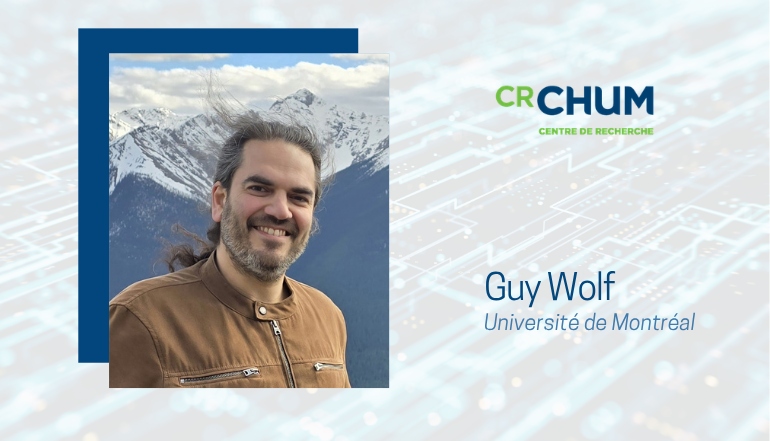
Guy Wolf appointed to strategic leadership roles in artificial intelligence at the CHUM and CRCHUM
The Centre de recherches mathématiques (CRM) warmly congratulates Guy Wolf on his appointment as [...]
Canada-France Collaboration
Find the latest opportunities for collaboration between Canada and France here. Session for [...]
France-Quebec Research Stays: Call for Applications
Deadline: November 1, 2026 The CRM offers funding to support research visits for its [...]