Publications
Le Bulletin du CRM
Le Bulletin du CRM is returning in a new format
Starting in Fall 2025, Le Bulletin du CRM is taking on a new format. The CRM is soliciting articles of interest to our members and readers which will be published on our website.
Please contact publications@crm.umontreal.ca to contribute future articles in French or English.
ARTICLES
As we enter the new academic year with its promises and challenges, let us reflect on the excitement and beauty of the human enterprise of mathematics, as experienced at the International Congress of Mathematics (ICM 2026) by Henri Darmon (McGill), and at its satellite conference IWOTA 2026 in Quebec City by its organizer, Javad Mashreghi (Laval).
2026: A Mathematical Odyssey, an account of the Philadephia ICM
by Henri Darmon (McGill University).
International Workshop on Operator Theory and its Applications
An ICM Satellite Conferenceby Javad Mashreghi (Université Laval).
Thematic Program “Mathematics for Health”
by Bouchra Nasri and Vanessa Bellegarde (Université de Montréal).
This article introduces the exciting thematic program “Mathematics for Health,” which began in late July 2026 at the CRM. Read all about the upcoming activities and mark your calendars
Montreal Industrial Problem Solving Workshops
by Odile Marcotte, lead organizer of the ARPI in Montreal from 2007 to 2024 (except in 2021)
This article contains a brief presentation of the Montreal Industrial Problem Solving Workshops (IPSW) that have been organized by the CRM since 2007.
Read the article
Since 2007 the CRM has been organizing Industrial Problem Solving Workshops (IPSW), also called study groups in England or “Semaines d’études mathématiques – entreprises et société » in France. During an industrial problem solving workshop (in general lasting one week), academic researchers, students, and representatives of private or public institutions are gathered to study and solve concrete problems through mathematical methods. Thus the IPSW organizers must find enterprises or institutions willing to submit problems to the workshop and also find researchers willing to coordinate the work of teams tackling these problems. The organizers must publicize the IPSW so that enough graduate students will take part in it. The workshop begins with a plenary session where each enterprise or institution describes its problem and ends with another plenary session where each team presents the work carried out during the week. Between the two plenary sessions the teams work independently from one another, but in some cases all participants gather at the end of the second day (for instance) to present the advances made by the teams. We refer the reader to the following page for the problem descriptions and proceedings of all the Montreal IPSWs.
The “IPSW model” was designed by mathematicians at the University of Oxford in the 1960s but was adopted by universities all over the world, including Europe (for instance the Netherlands, Portugal, and France), Canada, Mexico, Australia, and China, among others. The success of the Montreal IPSWs owes a lot to the location of research centres in the Montreal area: indeed, in the André-Aisenstadt pavilion of the Université de Montréal, one finds the CRM itself, the Department of mathematics and statistics, the Department of computer science and operations research, and GERAD and CIRRELT, two centres whose members apply methods from operations research to problems arising in transportation, energy planning, economics, and other fields. This concentration of academic researchers in the mathematical sciences enabled the IPSW organizers to recruit team coordinators and, in some cases, to find workshop problems thanks to previous links between professors and enterprises.
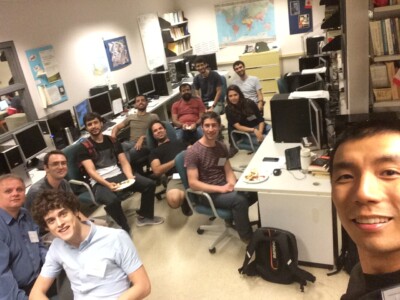
The team led by Mike Lindstrom (University of Texas Rio Grande Valley) working on a Radio-Canada project in August 2023.
The types of problems submitted to IPSWs have changed somewhat over the years, even though a workshop may include any problem that can be tackled by mathematical methods. The first IPSWs in the Montreal series included several problems related to operations research or differential equations or PDEs. In the recent IPSWs statistics and artificial intelligence (in a broad sense) have been used to examine and solve most of the problems submitted to the workshops. The number of problems in a given workshop has been comprised between 4 and 9: in our opinion the ideal number is 6! From 2007 to 2013 the workshops were organized thanks to grants from MITACS (a network of centres of excellence) and its successor Mprime. From 2015 to 2017 they were organized thanks to the Institutes Innovation Platform, an NSERC program. Since 2019 the main source of financing for the workshops has been the IVADO consortium, whose industrial members also provide many problems to the workshops. The CRM is grateful to all the institutions that have ensured the funding of the Montreal IPSW series.
We conclude this article by outlining the reasons why participants enjoy the IPSWs. The enterprise representatives are delighted to meet experts that examine their problems and propose solutions that they can assess. The researchers coordinating the work of their teams can use their expertise to solve concrete problems and initiate collaborations with public or private institutions. Graduate students can gain experience that will be very useful in their future jobs. Finally, as the Montreal IPSWs welcome participants from several countries and even several continents, researchers and students are able to meet (and work with) colleagues they would not have met otherwise.
La direction des mathématiques du CNRS visite le CRM-CNRS
by Emmanuel Royer (Université Clermont-Auvergne and Director of CRM-CNRS).
On October 20 and 21, 2025, a delegation from the CNRS visited the IRL CRM-CNRS. The director of this laboratory, Emmanuel Royer, provides us with a summary of this visit as well as an introduction to the history and mission of the CNRS, and to opportunities for cooperation between France and Quebec.
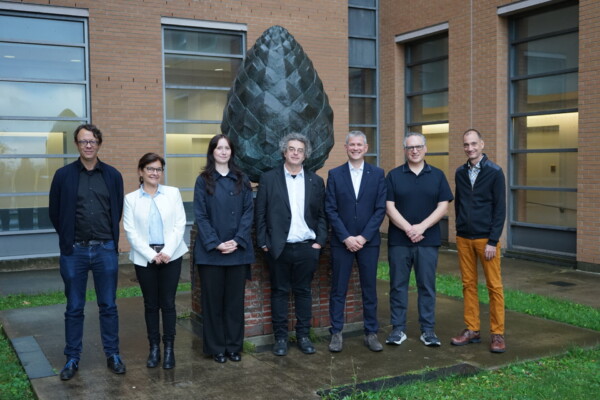
From left to right: Frédéric Hérau, Andrea Dessen, Suzie Bronner, Emmanuel Royer, Christophe Besse, Franco Saliola, and Benoit Durand-Jodoin.
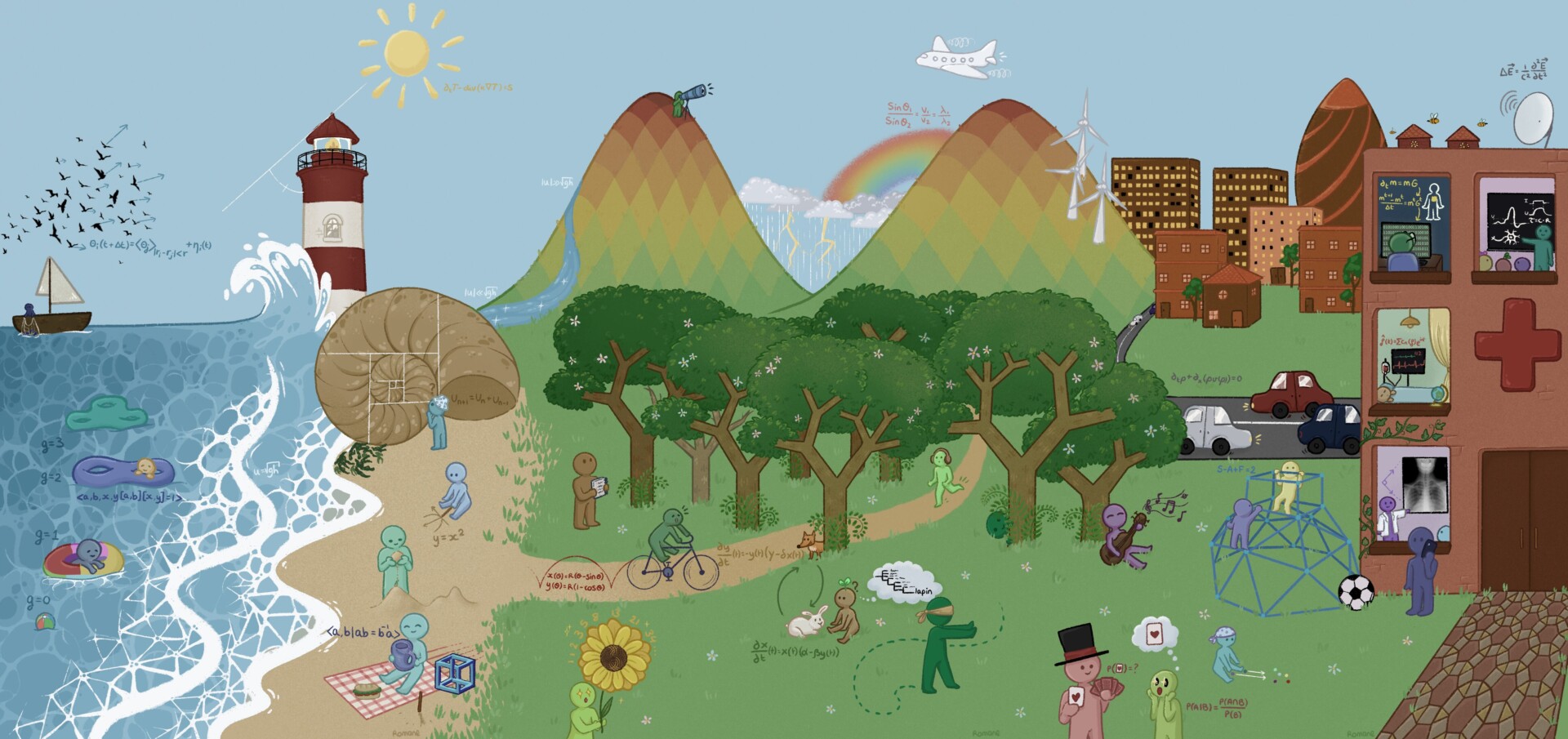
Un paysage mathématique
by Hélène Guérin (UQAM) and Barbara Schapira (Montpellier).
A small group of mathematicians, with occasional help from many other people (from France, Quebec, and Switzerland) and the assistance of Quebec illustrator Romane Charpentier, created a poster designed to show the variety of mathematical research rooted in the real world.
This poster is intended for events aimed at the general public, and an accompanying document (in French) has been written for colleagues who would like to use this poster to show the diversity and importance of research in mathematics.
A short summary (in French) and a high-definition version of the poster for printing are available here: https://kits.math.cnrs.fr/node/213
Mathematical Foundations of Data Science: What a wild ride!
By Simone Brugiapaglia (Concordia) and Tim Hoheisel (McGill)
The organizers of the thematic program held at the CRM from May to June 2025 reflect on their experience.
Congratulations to Simone and Tim for their outstanding organization, which made this program a true success.Paul Koosis (1929-2025): A Life Devoted to Mathematics and Culture
By Javad Mashreghi (Laval University).
In memory of Paul Koosis, who contributed to the mathematical community and the CRM in many ways, including some outstanding books which appeared in the CRM’s publications.
ARCHIVES
AT A GLANCE
- Geometric Analysis
- Computational Dynamics
- Grandes conférences
- CRM Nirenberg lectures
- Prizes
- CRM Distinguished Research Scholar
- Post-docs
- Women in mathematics
- En avant Math !