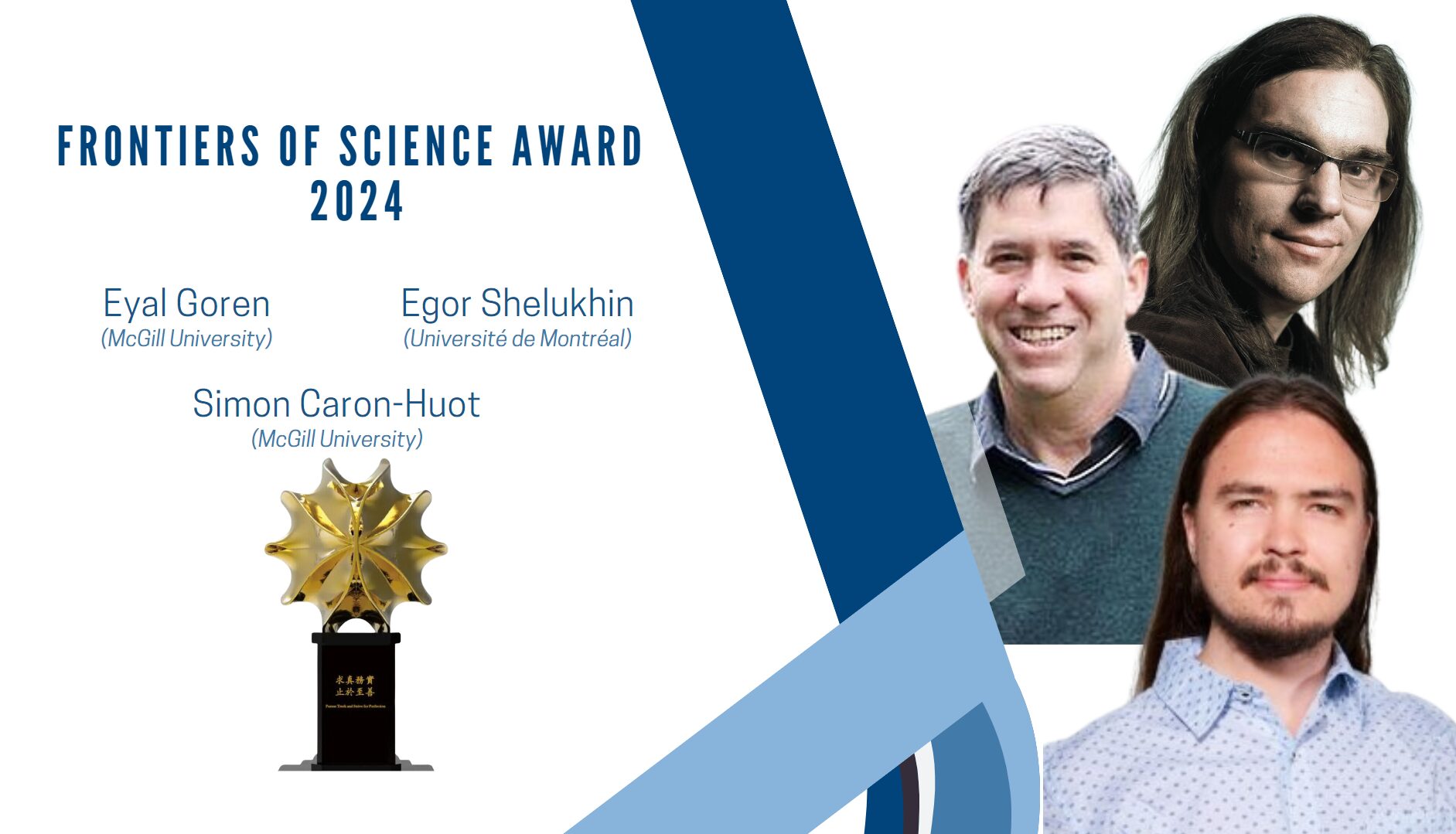
Three CRM members receive Frontiers of Science Award 2024
Eyal Goren obtained his PhD from the Hebrew University of Jerusalem in January 1997, under the supervision of E. De Shalit. After a postdoctoral period at Harvard University and the University of Utrecht, he arrived as a postdoctoral researcher at McGill University, where he became assistant professor in June 1999 and full professor in June 2009. His research interests include moduli spaces of abelian varieties and curves, modular forms, complex multiplication and expansion graphs.
Egor Shelukhin obtained his PhD from Tel Aviv University in 2012 under the supervision of Leonid Polterovich. After a post-doctoral fellowship at the CRM, Université de Montréal, he was a member of the Institute for Advanced Study at Princeton before becoming an Adjunct Professor at Université de Montréal, where he now holds a Chaire Courtois. He was awarded the André Aisenstadt Prize in 2020. Shelukhin works in symplectic topology and dynamical systems, using approaches involving Floer theory, geometric quantification, quasi-morphisms and persistence modules.
Simon Caron-Huot obtained his PhD from Montreal’s McGill University in 2009 under the supervision of Guy D. Moore. He was then a member of the Institute of Advanced Study at Princeton and assistant professor at the Niels Bohr Institute in Copenhagen before returning to McGill University in 2016, where he is now associate professor since 2022. He works on various applications of quantum field theory and in particular conformal field theories and strongly interacting systems.
The International Congress for Basic Science (ICBS) honours cutting-edge research, focusing on achievements over the past ten years that are of outstanding academic merit. For the 2024 selection, scientific works in fundamental and applied research are chosen from 42 areas of the three basic sciences (mathematics, theoretical physics, theoretical computer science and information science) represented at the ICBS. To be considered, a scientific work must meet the following three conditions: (1) it must have been published within the last ten years; (2) it must be of great scientific value, be highly original and have had a significant impact in its field; (3) it must have been evaluated and accepted by researchers in its field.
The aim of this prize is to encourage young researchers to look to the frontiers of fundamental science, to set themselves goals to achieve revolutionary results as soon as possible, and to contribute wisely and energetically to the study of the mysteries of the natural world.

France-Quebec Research Stays: Call for Applications
Deadline: November 1, 2026 The CRM offers funding to support research visits for its [...]
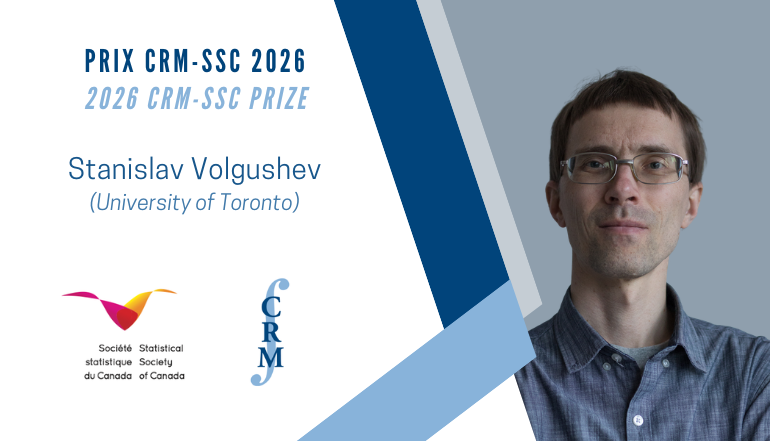
2026 CRM-SSC Prize lecture – Stanislav Volgushev
Friday, October 30, 2026 at 3:30pm Hybrid – Université de Montréal, CRM Pavillon André-Aisenstadt, 6th [...]
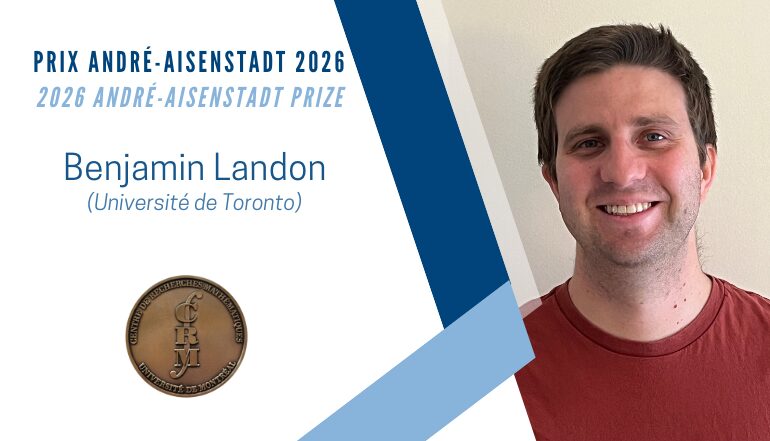
2026 André Aisenstadt Prize lecture – Benjamin Landon
Friday, October 23, 2026 at 3:30pm Hybrid – Université de Montréal, CRM Pavillon André-Aisenstadt, [...]